Showing posts with label china. Show all posts

Saturday, November 8, 2008

Chinese Car Dealers Cry, Close

Ever wondered why cars can be so cheap in China? Now we know why: More and more cars are being sold at a loss in China, Gasgoo reports. In WTO terms, this will probably be misinterpreted as domestic dump(l)ing. While Chinese dealers are accustomed to the same clear-the decks strategies at year’s end as their Western colleagues, the price cuts come a bit too early in the now Middling Kingdom.
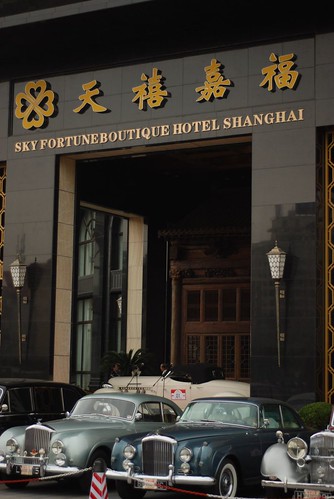
Like their Western brethren, Chinese dealers are used to profit margins between 3 percent and zilch. But now, more often than not, it’s south of nada. No wonder many Chinese dealers are following the worldwide trend, close their lot, and seek other employment. Like teaching English (see picture.) A third of them are expected to close shop by year’s end. The more vociferous ones are blaming the manufacturers for overstocking and too demanding sales targets. A familiar song for Western experts. A survey says that over 40 percent of Chinese car dealers in China make no money. A familiar song for Western experts. Ah, the joys of capitalism!

(Picture courtesy d_j_kingpin @ flickr.com)

Monday, November 3, 2008

Chinese High-Rollers High On Rollers

(First published in TheTruthAboutCars on November 2, 2008)

It’s not yet that Chinese mothers admonish their one-and-only child to “eat up, there are children starving back in America.” But it’s getting close. Case in point: This weekend, another Rolls-Royce showroom opened in Shenzen, Gasgoo reports. It’s the seventh Rolls Royce retail location in China. Another one, located in China’s industrial center Ningbo, will open its doors in a few months. Rollers are on a roll in China. I counted two Phantoms alone in the underground garage of my Beijing building.

At the Shenzen opening, Rolls presented their new Rolls-Royce Phantom Coupé to the Chinese public. It’s their entry model. “Nearly two-thirds of Coupé customers worldwide have not owned a Rolls-Royce before,” said Jenny Zheng, Rolls-Royce Motor Cars’ General Manager for Greater China. BMW are thanking their lucky stars…

While Rolls-Royce’s parent BMW saw its global sales slide by 15 percent in September, Rolls flipped their Emily at the flagging economy, and increased sales by seven percent in the same month. Year-to-date, Rolls-Royce sales rose a record 43 percent year-on-year. Granted, that total was only 827 cars. But in this economy, every car counts. Especially as each example retails at $415k base - and no true Roller proprietor will get caught in a riff-raff reeking base model. “There’s been an 80 per cent increase in the number of vehicles sold this year with some form of bespoke element,” says the British Autocarmagazine with the appropriate nasal accent. Not surprisingly, sales in the United Arab Emirates are up by around 70 per cent. China? Fifty percent rise.

You think it’s a fluke? Further in the same vein(ity), New Delhi’s Financial Express reports “that Mercedes Benz India has registered an impressive 47% growth in car sales for the first 10 months of the current calendar year.” Sales of C-class Benzes more than doubled. Holy cow! And by the way, Time Magazine already said two years ago that Chinese children are getting fat.

(Picture courtesy Kaeyau. Thank you!)

Wednesday, October 22, 2008

Getting Out Of Dodge. Heck, All Of Detroit.

While billionaires defect Detroit, Chinese women buy new cars with 3 months of breastfeeding.

In a sign that the worst is yet to come, turn-around artists are turning their backs on Detroit’s auto makers. Billionaire Kirk Kerkorian is unwinding his holdings in Ford Motor Co. , after his nearly one billion dollar investment (made when he thought Ford was cheap) lost two thirds of its value and is heading further South. Kerkorian had to pledge 50 million shares of his MGM Mirage Casino to back the credit line he used to buy into Ford. The house is clearly on fire when supposedly recession-proof investments in vice are pawned to prop up auto makers. (However, even vice isn’t what it used to be.)

Stephen Feinberg’s Cerberus, urged by JPMorgan Chase & Co. and Citigroup Inc., which hold a lot of the debt from Cerberus's purchase of Chrysler from Germany's (then) DaimlerChrysler AG in August 2007, is desperately trying to unload Chrysler and foist it upon GM. Cerberus is also talking with Nissan Motor Co. and Renault SA about a linkup, but that’s just viewed as a side show to lend more urgency to the wedding with GM. The Chrysler/GM nuptials have been talked up in the mainstream press as a gift from heaven, as a “win-win” situation full of “synergy” potential. These words rank big in the Dictionary of Corporate Bullshit - the smart make a runner for the door when these words are used. In a particularly apt analogy, our friends over at TheTruthAboutCars liken the Chrysler/GM shotgun wedding to the “Titanic rescuing the Lusitania.” (If Google is an indicator, they should trademark the term.)

“Typical investors, and Cerberus is anything but typical, are running from the automotive industry,'' said Warren Feder, partner at Carl Marks Advisory Group LLC in New York. “It's hard to see any upside with a degree of comfort, and you need that to make an equity investment.''

U.S.A.: Less than 11 million cars in 2009?

JPMorgan Chase & Co, who should have a vested (see above) interest in painting a rosy picture of the auto industry, just did otherwise. U.S. auto deliveries may fall to an annual rate as low as 10 million vehicles this quarter and as low as 11 million next year, Himanshu Patel, an analyst at JPMorgan Chase & Co. in New York, wrote in a report on October 21, 2008 . A few days before, J.D. Power and Associates still had estimated 13.2 units sold in the U.S. for 2009. Patel’s 2009 estimate would be the lowest rate since 1982. The predictions get worse by the day.

China may sell more cars in 2009 than the U.S.

If Patel is right (and, see above, his firm has a lot of hard earned insider knowledge about the auto business,) and if China maintains a – by Chinese standards – rather sedate growth rate , come 2009, the Chinese auto market might be the same size or even larger than the U.S. The China Association of Automobile Manufacturers, had targeted 10 million units for 2008, but with growth slowing in China, the Eastern Empire may not quite make it this year. Next year, unless the sky will fall, 11 million are entirely doable.

U.S. auto industry goes hungry. Babies too.

In the meantime, according to Bloomberg, the exit of Kerkorian, Cerberus & Co. “may leave the U.S. auto industry without new funding just as sales head to a 26-year low.”

Here comes a really disturbing bit of data: "Most consumers are worried about: 'Will I have enough to put food on the table so my family can eat?' Eduardo Castro-Wright, President and CEO of Wal-Mart's U.S. operations told attendees of a luncheon sponsored by Town Hall Los Angeles. His stores see spikes of sales of baby formula when paychecks come in, “suggesting consumers are rushing to buy such necessities as soon as they have the cash,” Reuters reported.

“As the economy worsens, Wal-Mart's customers have increasingly shown signs of living paycheck to paycheck. Wal-Mart's sales typically surge around pay periods at the beginning and middle of the month. Castro-Wright said that spike has become more pronounced as consumers' budgets become more stressed.”

Buy a new car with 3 months of breastfeeding.

Contrast this to China. In the wake of the milk worries, affluent Chinese parents of babies more and more turn to “milk mothers” or “Nai Ma” who breast feed their new-borns if the real mother doesn’t want or can. Baby formula? No, thank you. Or "bu, xie, xie," as they say. They want the real thing for their one child only. In Beijing, a milk mother from the provinces can make between $300 and $1600 a month, with free room and board. A secretary in Beijing starts at around $300 a month, and must use the money to pay for food and shelter.

Back to cars: A family that barely can feed their babies is unlikely to worry about a new ride. A Chinese milk mother can buy a new car for cash with three or 5 months earnings. While the International Breastfeeding Committee of WHO/Unicef recommends breastfeeding for six months, Chinese hospitals recommend a year or more. After a year’s of not really hard work, the milk mother will have two or three cars. Meanwhile, back in the U.S. of A. , parents need parts to keep their cars running, at least twice a month, for a trip to Wal-Mart.
-----
Pictures by epicharmus, Dr. Keats, Brave New Films. Thank you!

Monday, October 20, 2008

The Sky Is Falling! China Grows “Only” 9%!

Bloomberg reported today that “China's economy, the biggest contributor to global growth, expanded at the slowest pace in five years as the financial crisis cut demand for exports. Gross domestic product rose 9 percent in the third quarter from a year earlier.”

Economy caught SARS?

To juice up the news, Bloomberg said that “China's expansion was the weakest since the severe acute respiratory syndrome, or SARS, epidemic slashed growth in the second quarter of 2003.”

To old China hands, this conjures up some of the worst memories, when China came to a grinding halt for months, while everybody had to stay home and was allowed to go to the shop once a week with guns pointed at you, worn by soldiers in HAZMAT gear. Can’t get any worse than that.

Only 9% growth?

The New York Times rightly said: "Policy makers in almost any country except China would be delighted with 9 percent growth, particularly given the financial turmoil that was worsening at the end of the third quarter." Well, maybe not: A 9% rise of GDP would make the rest of the world scared that central bankers will raise interest rates to stem off inflation.

Only 9% growth? China simply goes from an unsustainable, unhealthy and inflationary double digit growth to a healthier level.

Sure, export growth in China slowed substantially. It had to. Since the second half of 2007, the Chinese government tried everything to push down exports to a more sustainable level.

However:

- Retail sales in China rose 23.2 percent in September from a year earlier, matching the gain in August and close to the fastest pace in at least nine years.

- Urban disposable incomes for the first nine months rose 14.7 percent to 11,865 Yuan from a year earlier. Rural cash incomes climbed 19.6 percent to 3,971 Yuan.

- The formerly red-hot Chinese light vehicle market (which includes passenger vehicle and light commercial vehicle segments) is expected to slow in 2008, but it still will grow at very healthy rates. J.D. Power expects Chinese light vehicle sales to come in at 8.9 million units in 2008, which would be an increase of 9.7 % compared to 2007.

- Much of the decline in exports had been caused long before the U.S. meltdown. The cause was the appreciation of the RMB, which was actually a reflection of the rapid depreciation of the USD which took place until July 2008. As gasgoo.com said, "For most local auto parts makers, the impact on exports brought by the demand slowdown of the global market triggered by the financial crisis will be less than that of the RMB appreciation." It’s just that nobody was looking.

The stock market knew it long before.

The Chinese stock market could crash from 6000 at the beginning of 2008 to around 2000 now without anybody outside the country batting an eye. Since January, the Chinese stock market lost more than 60%, and nobody wanted a bail-out.


The Dollar comes back. The Yuan barely moves.

If anybody has noticed, the USD took a sharp turn and appreciated dramatically since July. Now is this reflected in the USD/CNY currency pair? Have a look at the chart:


Until July, the Yuan pretty much appreciated against the USD as the Euro did. The Dollar went down, the Euro and the Yuan went up.

What happened when the USD started rising like mad, starting in July? The USD/CNY rate barely budged. The EUR/CNY rate did move.


Bloomberg says that the Chinese "central bank has stalled gains by the Yuan against the Dollar since mid-July, protecting jobs in export industries."

Hmmm. The chart says they did just the opposite. When the Yuan should have gone down sharply against the USD along with the other currencies (except the Yen, but that's a different story) the Yuan barely moved.

The chart says that the Chinese central bank may have propped up the Yuan against the US Dollar. China also took other measures to cool down their overheating export machine, such as not refunding parts of the VAT for exports, and actually charging export tax on certain items.


Yuan due for a fall.

Expect the USD/CNY rate to change radically within the next months, latest after the U.S. elections. We expect the Yuan to drop against the USD, the easiest way for the Chinese government to make Chinese exports more attractive. In the first half of 2008, this would have been a rather unpopular move. But now, the world has other problems than watching the CNY/USD currency pair. The New York Times opined: "With the United States heavily dependent on China to buy the Treasury bonds needed to finance a bailout of the American financial system, the Bush administration has stopped criticizing China’s trade and currency policies."
If anyone does complain, the obvious explanation is that in light of the strength of the Dollar, the Yuan must follow suit and go down.

And when the USD will drop when America will crank up the presses to print money to finance the bailout and two wars, the Chinese can keep the USD/CNY level, and make their goods even cheaper in Euro terms.

More toggles to be switched

Likewise, the tax measures designed to dampen exports are expected to be lifted. Sharply lower commodity prices and equally lower transport prices make low wage countries like China even more competitive.

China is the country that keeps the world economy alive. The Chinese have the incentive and financial wherewithal to keep it that way. They have nearly unlimited room to grow, while Western markets are saturated and while especially European and Japanese demographics indicate shrinking markets. Like it or not, out of this recession, China will emerge stronger than ever.

Sunday, October 19, 2008

Chinese Car Exports: A Non-Starter?

For the past years, auto makers in Europe and the U.S. looked to China with hope, and with trepidation. They hoped the booming Chinese market would lift their worldwide sales. It did. They feared the Chinese would export cars en masse, swamping Europe and the U.S. with cheap vehicles. They did not. China didn't ruin Western markets. Western banks and brokerages did.

Weapons of mass destruction.


Nevertheless, red alert was sounded each time a Chinese car appeared at an auto show in Frankfurt, Geneva, Paris, or Detroit. Weapons of mass destruction were deployed to ward off a Chinese invasion: Chinese cars were crashed, and grisly results were published, sometimes coincidentally timed adjacent to those auto shows. An insider close to the matter said: “If you have a lot of money, you can crash a lot of cars. There’s always one crash that looks real horrible. That’s the one you will see on YouTube.”

What you see here is the infamous Landwind test by the German AUTO Club ADAC. The test was rumored to have been under the influence of German auto makers, and that the impact was at a higher speed than necessary. A later test by TÜV confirmed that the Landwind met all mandatory safety criteria according to ECE R94. But the damage was done, sales of the Landwind remained in the doldrums.

This time, the markets crashed.

This year, also quite coincidentally, there were no terrifying crashes of Chinese cars before the Paris Auto Show. Likewise coincidentally, Edmund’s AutoObserver reported from the show: “The era of Chinese car exports may have ended before it even began.”

Only two Chinese auto companies showed up for the show. One was Brilliance, BMW’s joint venture partner in China. The other was the French distributor of Shuanghuan Automobile. Neither garnered a lot of attention.

This time, no cars needed to be crashed. What did crash, were the auto markets. Auto sales in the U.S. were down 26 percent in September. In Japan, car sales are at their lowest level in more than thirty years. European markets are faring poorly.

Chinese new car exports drop.

This was immediately felt in Chinese new car export numbers. August witnessed the first monthly decline over recent years in China's car exports, due largely to shrinking demand overseas. According to the China Association of Automobile Manufacturers (CAAM), China sold abroad 44,400 motor vehicles in August 2008, down 22.18 % from the previous month, or 11.29 % from a year earlier. Analysts see this trend to accelerate as the full impact of the market crash is being felt, and as the cars in the pipeline from China remain unsold.

In 2007, China had exported a total of 612,700 vehicles, up 78.95 % from a year earlier. For the first eight months, the total Chinese auto export value rose 36.5 percent year-on-year. Experts expect a decline for the rest of the year.

Parts fare better.

For auto parts, the picture is not as grim at all. Sure, according to Gasgoo, Chinese parts makers who focused on foreign new car manufacturers, saw their sales “drop significantly this year.”
Manufacturers who target the after-sales market fare much better “with many people preferring to maintain cars rather than buying new ones.” The semi-official newspaper China Daily said: “the US and the European customers' preference for China-made auto parts, which are more competitive in price, provide much better opportunities.”

Saturday, October 18, 2008

Worldwide Auto Sales: The Good, the Bad, and the Downright Ugly.

J.D. Power and Associates, one of the few reliable sources on worldwide automotive data, have released their forecast for 2008 auto sales. Executive summary: It won’t be pretty.

All corners of the world will be affected by the slowdown. But not all corners will see equally dismal sales. The mature and saturated markets will be hit hardest by a sudden lack of appetite for new cars. Emerging markets will continue to grow – albeit at a much slower pace. The after-sales business will profit from people holding on to their cars.

The Good: China.

The formerly red-hot Chinese light vehicle market (which includes passenger vehicle and light commercial vehicle segments) is expected to slow in 2008, but it still will grow at very healthy rates. J.D. Power expects Chinese light vehicle sales to come in at 8.9 million units in 2008, which would be an increase of 9.7 % compared to 2007. Still, the number will be much tamer than the 24.1 % growth achieved in 2007. (The Indian light vehicle market will remain in its infancy. 1.8 million units are expected to change hands in 2008, nearly the same as in 2007. Considering that India has approximately the same population as China, 1.8 million units are pretty much a non-event when measured with a global scale.)

The Bad: Europe.

Light-vehicle sales in Europe as a whole are projected to fall to 21.3 million units in 2008. This would be a rather tame 3.1 % decline compared to 2007. For Western Europe, where markets are more saturated, J.D. Power forecasts a decline to 15.6 million units sold, which would be 7.5 % less than 2007. Eastern Europe will still see growth. Eastern European unit sales are anticipated to be 5.8 million in 2008, a surprising (giving the circumstances) jump of 11.3 % compared to 2007. However, growth in Eastern Europe is also forecasted to slow significantly.

The Downright Ugly: U.S.

J.D. Power and Associates forecasts total U.S. new light-vehicle sales to plummet to 13.6 million units in 2008, a 16 % decline from the 16.1 million units sold in 2007. For 2009, J.D. Power and Associates sees even lower numbers: 13.2 units. J.D. Power says the numbers may be 200,000 lower, depending on how the 4th quarter of 2008 may play out.

Net/Net.

J.D. Power doesn’t think that the market will recover anytime soon. Jeff Schuster, executive director of automotive forecasting for J.D. Power and Associates, said that “any truly pronounced recovery appears to be more than 18 months away.” And it may get worse before it gets better: “While the global automotive industry is clearly experiencing a slowdown in 2008, the global market in 2009 may experience an outright collapse,” Schuster said. “While mature markets are being impacted more severely than emerging markets, no country or region is completely immune to the turmoil.”

No crisis for after-sales.

Like other analysts before, J.D. Power observed that “approximately two-thirds of the decline in retail sales can be attributed to consumers delaying vehicle purchases.” People are keeping their vehicles longer. Keeping their vehicles longer means more parts and labor are needed to keep the vehicles running. Buying a new car or even a used car can be delayed. But if the brakes fail, it’s either buy new ones or walk. One of the few recession proof segments in this collapsing economy appear to be parts and services.

------
Picture by SmokingPermitted. Thank you!

Thursday, October 16, 2008

GM wants their money back

Bob Lutz, GM's vice-chairman, said GM is making plans to move money from Chinese operations to the U.S. in order to to compensate fo North American losses. Since nobody seems to want to buy the Hummer brand, which GM put up for sale, repatriating profits from China is one of the few options left for GM.

Desparate times.

Draining the huge, vibrant and growing China market of funds while the rest of the world tanks doesn't sound like such a good idea, but these are desperate times. "We do not rule out such a possibility under current conditions,” Lutz said. (Translation: We are already preparing the transfer.)

GM had been doing really well in China since they started producing vehicles here in 1999. This has changed. The Volkswagen Group again is China's market leader in passenger vehicles. GM is also being outsold by Toyota in passenger vehicles. The gap may widen if Detroit pulls out marketing and development funds from China.

Already, General Motors Corp. Asia Pacific President Nick Reilly said the company's vehicle sales in China fell in August and September from a year earlier. He also isn't too sure about GM's previous forecast of of 11% to 12% overall sales growth in the Chinese auto market for 2008. "The market is too unpredictable to forecast with any credibility," Reilly said. (Translation: Prepare for the worst.)

SAIC won't like it.

Their joint venture partners will not be amused by GM wanting their money back when cash is king and credit is an endangered species.

General Motors has several JVs in China through mergers of local companies jointly held with the Shanghai Automotive Industry Corp (SAIC) - one of China's top three automakers. SAIC is also an important JV partner of Volkswagen, and if the money flows back to Detroit, SAIC may like the Germans even better. Volkswagen doesn't need the money, their stock is skyrocketing (see real time chart on the left) while the rest of the world is going to the toilet.

------
Picture by mikecolvin82. Thank you!

Chinese Numerology: Complicated Car Ban in Beijing

In the last few years, Beijing became more famous for its thick smog than for the Imperial Palace. Not wanting to be embarrassed during the Olympics, and after a lot of head-scratching, the City of Beijing had resorted to what insiders called the “Nigeria Solution:” Cars with license plates ending in an odd number were allowed to drive on odd days, cars with even numbers on even days of the month.

The Nigeria Solution.

In the 70’s, the same had been tried in Lagos, Nigeria. The city of 7 million suffocated in gridlock. Lagos instated the odd/even rule. A friend of mine, who was sent to Lagos by Volkswagen to help launch their new plant in Nigeria, called the rule “the best marketing campaign we ever had – and it was free.” People who had the money simply bought a second car and kept on driving.

Beijing’s car dealers hoped the city would keep the odd/even rule after the Olympics. Instead, China’s capital came up with a rule that could have been invented by Kafka:


  • Cars with a license plate ending in 1 or 6 are not allowed to drive on Mondays.

  • Cars with a license plate ending in 2 or 7 are not allowed to drive on Tuesdays.

  • Cars with a license plate ending in 3 or 8 are not allowed to drive on Wednesdays.

  • Cars with a license plate ending in 4 or 9 are not allowed to drive on Thursdays.

  • Cars with a license plate ending in 5 or 0 are not allowed to drive on Fridays.

  • Cars with temporary plates, or with plates ending with a letter, are treated as “0” cars: No driving on Fridays.

  • Police, ambulances, fire trucks, busses, taxis and other public transport vehicles are exempt.

  • On Saturday and Sunday, everybody may drive.

  • The rule applies only within the 5th Ring Road.

  • The rule applies to privately owned vehicles from 6am to 9pm.

  • For company-owned or government-owned vehicles (except for the ones mentioned above) the rule applies around the clock.
Nightly mysteries.


How the authorities will notice whether a car is privately or company owned is anybody’s guess. My car is owned by my company. But they would have to pull me over and check my registration to find that out. Or will they follow motorists at night, call in their plate, and pull them over if it's a Friday, if the plate ends in a 5, and if the vehicle is registered with a company? They might just do that in Germany. But TIC: This Is China.

It gets even more complex: Each month, the deck will be reshuffled, and new days will be announced that are off-limits for certain numbers. By end of October, a Beijinger with a 1 as the last number on his plate has hopefully gotten it in his head that on Mondays, he has to take the subway or hitch a ride with his neighbor. Come November, he will have to unlearn everything. In November, it could be a Wednesday. And it could be a Tuesday in December. Or a Friday. Nobody knows. The traffic bureau will announce the new days a week before the start of a new month.

Numerology gone wild

It is no surprise that Beijing is a bit overwhelmed by the scheme. One would think that the Chinese are more attuned to numbers. Numerology is big in China. Vanity telephone numbers are unknown in China, because Chinese supposedly remember numbers better than letters. But even to the numerically superior Chinese, the scheme appears to be a bit too much. On Monday, I saw many cars with 1 or 6. On Tuesday, I saw a lot with 2 or 7. On Wednesday, many cars with 3 or 8 were on the road. They weren’t just on the road, they were on broadcast television. Footage of scofflaws who ignored the new rules ruled the airwaves. Nevertheless, I had to tell my driver that he would not be allowed to pick me up at the airport on Thursday, because of the number 4 on our plate. He never had heard of the rule, and he looked at me as if I'm a "250" - that's what the numerically superior Chinese call a daft person.

Beijing’s car dealers have new hopes that people will find an incentive to own a second car once the rules sink in. But what happens to the poor folks who have the bad luck of owning one car that has a 1 as the last number of the license plate, while their second car has – dammit – a 6?

Now you really need a second car.

Many had acquired a second car before the Olympics and had made sure that the plate ended in an odd number if the first car’s number was even. And now the investment is supposed to be for naught? The Traffic Bureau has mercy with these poor souls. They can go and trade in their license plate for an non-conflicting number. And with two cars, they can happily drive on all days of the week.

According to just released figures, 2 million more cars are expected to take to Beijing’s roads by 2012, bringing the total to 5.4 million. If the numbers-scheme stays in place, we could see 2 million more new cars by next year.

PS, Oct 17,2008

Shanghai will adopt a watered-down version of the capital's traffic restrictions, Gasgoo says. Starting in November, vehicles belonging to the government or state-owned enterprises will be banned from the roads on one out of five weekdays in a system based on license plate numbers. Privately owned cars will be unencumbered.


------
Picture by ernop. Thank you!

Tuesday, October 14, 2008

China’s auto parts export recession-proof, rises 34.9%.

What slowdown? Parts power ahead. By Bertel Schmitt, CEO Sinamotive Group (HK) Limited.

Despite the global slowdown, the Chinese auto parts industry powers ahead. In the first seven months of 2008, the value of China's auto-parts exports grew by 34.9% year on year (y/y) to $8.88 billion, China’s customs bureau said. From January to July 2008, China exported $ 8.73 billion worth of auto-parts.

Foreign invested companies and joint ventures exported $4.56 billion auto-parts, up 31.6% y/y, accounting for 51.4% of the total.

The three major destination markets of China-made auto parts are the U.S., EU and Japan. Parts for $2.69 billion (+8.8%) were sold to the U.S.A., parts for $1.6 billion (+39.2%) were sold to the EU, and parts for $1 billion (+36.8%) were shipped to Japan. These three markets contributed 59.6% to the total value of China's Jan-Jul auto-parts export.

This validates my company's previous analyses:

1.) The parts market, especially when targeted at after sales, is recession-proof.

2.) After diminishing growth in the U.S.A., more and more Chinese parts go to Europe.

3.) The main drivers of this growth are foreign companies, who use China as a low cost production base and sell the product under their own brand name at high margins. Bosch China for instance reported that their sales are expected to reach 2.3 billion Euros, which would be a 30% increase over last year. Jay K.Kunkel, President Asia Continental AG, said that the only risk is "not investing in China."

4.) With lower raw material prices and lower shipping costs, we expect further increases, especially in the after sales segment. The OEM segment should also grow, because the world’s auto makers try to off-set their lower sales by purchasing lower cost parts in China.
------
About the author: After having worked as a Marketing Consultant for Volkswagen AG for three decades, Bertel Schmitt changed sides in 2005 to found Hongkong, Beijing, and Hamburg based Sinamotive, a company specialized in sourcing low cost high quality auto parts in China. The company sells to major wholesalers in Europe.

China's auto industry getting the sniffles.

After double digit growth rates, China is taking it easy. By Bertel Schmitt, CEO Sinamotive Group (HK) Limited.

When times were good, the big automakers looked at China as a threat. When auto sales plummeted in the U.S., and fell in Europe, automakers looked to China to save their bacon. China won't disappoint. But it can't save them all. Sales figures just released by the China Association of Automobile Manufacturers, say that passenger vehicle sales in China fell for a second month in a row in September. They dropped 1.4% from the same period in the prior year to 552,800 vehicles. There are worries about a demand slowdown.

Still a very healthy rise: 11.4%

Still, sales of passenger vehicles in the January-September period increased by a healthy 11.4% to 5.1 million units. 2007 saw a rise of 21.8%. The September decline in passenger-vehicle sales indicates a full-year sales growth in the single digits. The decline came as a surprise, because September is usually a strong sales month in China, when consumers buy cars ahead of the Golden Week holiday.

Volkswagen AG was the hero. After so-so sales in prior years, VW sold 772,783 vehicles in China from January to September. This amounts to a 13% rise compared to the same period in the prior year. Volkswagen's Audi luxury brand contributed most. Volkswagen China plans to sell a million cars in 2008, which would translate to an increase of 9.8% from the 910,491 vehicles in the yedar before. According to VW's Finance Director, Volkswagen plans, for the first time in history, to sell more cars in China than in its home market Germany in 2008.

No saturation in sight.

The shift into lower gears doesn't mean that a saturation of the Chinese auto market would be near. China just started when it comes to cars. In 2007, the total number of vehicles in China was 57 million units. That total also counts 14.68 million three-wheeled vehicles and low-speed vans. As it stands, China's vehicle ownership per thousand populations is below 50. The number is 740 in the United States, and more than 500 in Europe. It will take a long time for China to reach saturation. Total world output is 69 million cars per year. Even if the whole world would produce cars for China only, it would take more than ten years to bring China's market to saturation.

How to make money with cars, without selling them.

How to profit from the worldwide new car sales slump. By Bertel Schmitt, CEO Sinamotive Group (HK) Limited.

The worst year for new car sales

Since decades, this is the worst year for new car sales, especially in the saturated markets of U.S. and Europe. US new car sales plummeted to a record low in September 2008. For the first time in more than 15 years, monthly U.S. sales fell below 1 million. Traffic in showrooms has come to a virtual standstill. Industry sales crashed by 27% to 964,873 vehicles. Likewise, the European new car market is on track to fall to its lowest level in more than a decade.

In Europe, the drop of new car sales is expected to be less dramatic than in the U.S. Analysts expect Western European volumes to decline 5% in 2008 and 3.5% in 2009. Analysts also expect Western Europe and the US to report approximately 14 million in new cars sold in 2008, with the outlook flat to lower in 2009. Some industry insiders, such as Katsuaki Watanabe, President of the world's largest automaker, Toyota, expect even lower numbers. Watanabe recently said that U.S. new car sales will probably end the year below 14 million.

U.S. industry sales could "collapse" in 2009, J.D. Power & Associates cautioned. Standard & Poor's warned of a possible insolvency of GM and Ford, "because of the rapidly weakening state of most global auto markets" and weak capital market conditions. Ford and GM promptly denied that they might file for bankruptcy. Instead, GM is in merger talks with Chrysler, after ending a flirt with Ford - as they did many times before, without ever consummating the marriage.

Profit from parts.

How can you make a profit with cars in such a dismal environment? Don't sell cars. Sell car parts. People may stop buying new cars. However, people can't stop driving. People simply hold on much longer to their older cars. Cars are having an increasingly longer usable life. Already, the average age of all cars on Germany's streets is 8.4 years. 10% of Germany's cars are over 16 years old. According to a recent study, the car park in Europe will rise from currently approximately 200 million to 275 million in 2025. The study also predicts that the average age of a car on Europe's streets will rise to 10.2 years in 2025. In the new European countries, the average age of the car is expected to rise to 14 years by 2025.

Older cars: A gold mine.

If you are in the business of servicing older cars, you are sitting on a gold mine. Nobody spends more for service and repair than owners of older cars. According to a recent DAT-Veedol Report, the annual average spendings for maintenance and repairs by German owners of cars that are less than two years old are EUR 109. Owners of cars older than 6 years spend close to EUR 500 per year for maintenance and repairs. The Wall Street Journal agrees: "As more consumers hold off on buying new cars, they're making more repairs." As older cars are subjected to wear and tear, expenses for service and repair are much higher than for new cars (which are covered by warranty anyway.)

Owners of older cars may spend more, but they are looking for value. Owners of older cars are price sensitive. The price of the repair bill should relate to the value of the car. The key to unlock this market are high quality, competitively priced parts.

Where to source these high quality, competitively priced parts? Mainly from China. China is the world's biggest exporter of auto parts. Auto manufacturers worldwide have been buying their parts in China for years. Japanese, European, and US automakers source parts used for production in their home markets in China. According to the report, GM buys 20 million parts a month from 190 Chinese suppliers, and had experienced no quality problems over the past year. What's more, most brand-name parts are already manufactured in China.

Now more than ever, sourcing car parts in China makes dollars and cents:

Metal prices, which saw a wild run-up in the first half of 2008, have been coming down since July. In October 2008, Aluminum fell to a 31-month trough on the deteriorating health of the car industry.

Steel prices are also falling. There were reports of panic selling . Forbes quoted an analyst who said that steel prices are "coming down hard and fast" as the economies of the United States and Europe deteriorate and growth slows in China.

Rates for container shipping are falling dramatically. "Barely 12 months ago carriers were making record profits in the Asia-Europe trade but from summer 2008, freight rates have plummeted and appear to still be in decline," said Neil Dekker, editor of the Annual Container Market Review and Forecast 2008/2009 for London-based Drewry Shipping Consultants. The Baltic Dry Index which measures freight rates for shipping has crashed by 82% since May, touching a five-year low. Container vessels are leaving Asian ports with 20% spare capacity. The banking crisis has affected letters of credit, essential instruments for international trade.

China's domestic auto sales will most likely see 2008 growth rates of under 10%, just released figures by the China Association of Automobile Manufacturers say. In the previous years, China had experienced double digit growth rates. The reduced domestic demand for OEM parts is expected to apply additional pricing pressure on parts manufacturers.

Private labels boost revenue.

That's why many repair chains and wholesalers in Europe and the U.S. are gearing up to launch their own private label parts lines, sourced in China. There is a huge profit potential. Many parts can be sourced in China for a fraction of their European and U.S. retail prices. According to Kyu-min Oh, senior industry analyst for the Automotive & Transportation team with the international reserach firm Frost & Sullivan, resellers are heading towards white-box brands to help boost revenue. "Profit margins when selling name-brand items are typically 30 to 40 percent, while the margins made when selling private labels are closer to 70 to 75 percent," the analyst said.


--------
Author Bertel Schmitt is looking back at a 30 year career as a marketing consultant to Volkswagen AG. He is now CEO of Hongkong, Beijing, and Hamburg based Sinamotive, a company specialized in sourcing low cost high quality auto parts in China. The company is backed by U.S. venture capital.