Tuesday, November 4, 2008

How Porsche Buggered the Hedge Funds

(First published by Bertel Schmitt in TheTruthAboutCars on November 3, 2008)

So you thought Porsche financed the VW takeover by foisting overpriced floormats and trucks on their well-heeled buyers? Yesterday’s issue of Die Welt, Germany’s conservative newspaper, thinks different. They undug the dirt on Porsche’s takeover-machinations of Volkswagen. It’s a story that makes Cerberus look like a frisky puppy. It’s an account that makes banks and hedge funds look like morons.

In March 2005, Porsche Chief Wendelin Wiedeking, and his clever CFO Harald Härter traveled to the picturesque Salzburg. They presented to the Porsche/Piech clan their strategy to subjugate the auto giant Volkswagen. The cunning plan: Porsche buys VW for no money. Make that: Porsche bamboozles hedge funds– supposedly the smartest of the smart– into unwittingly forking over the cash.

The Porsche/Piech clan liked the plan, and it was set in motion. Unspoken, but obvious: that meeting included – virtually at least – Ferdinand Piech. As all car cognoscenti know, Ferdinand Piech owns a good chunk of Porsche, and serves as the head of Volkswagen’s Supervisory Board. Did he exercise the powers vested into him, and warned the shareholders of VW of the machinations? We don’t think so.

Using the whole arsenal of arbitrage, swaps, puts, straddles, fraptions, and butterflies, Porsche drove the VW share up, while the hedge funds, fixated on the fundamentals of the flopping auto market, sold short. Porsche used every available loophole of the German law: A swap for instance doesn’t need to be registered. Porsche owned more and more of VW without anyone noticing. Porsche/Piech controlled the news. They could buy low, sell high, and with leverage that would have put the awe in Archimedes. The proceeds were used to buy more stock (to move it) and more options (to make more money.)

Over the years, Porsche kept people guessing why they would invest into VW at all. Three years ago, Porsche announced to an astounded world that they bought 20 percent of VW’s stock. They positioned themselves as the benign white knight that kept VW’s vestigial virginity from being gang-raped by rabid Auslandskonzerne (foreign corporations.) If anybody asked where this would lead, no answers followed.

Did Porsche want just a small chunk of VW? Or a blocking minority of 25 percent? Or, gasp, would they go for 51 percent? When questioned, Wiedekind assuaged the markets: “We are not going for a blocking minority.” A few months later, Porsche had more than 25 percent. Reminded of what he had said before, Wiedekind smiled. He had not lied. A blocking minority was not what they had in mind. They wanted the whole kit and caboodle.

In the meantime, Porsche conducted the orchestra of financial instruments like a Kapital-Karajan. Their financial fiddling did not remain completely unnoticed. Says the Economist, a bit belatedly: “The risks of short selling should have been apparent to the brightest hedge-fund managers in Mayfair and Greenwich because of widespread suspicion that Porsche, a dab hand in currency-derivatives markets, was also mucking about with options on VW stock.”

Indeed, Morgan Stanley warned clients on October 8th to refrain from playing “billionaire’s poker” by betting against Porsche. Max Warburton of Alliance Bernstein correctly predicted Porsche could make billions by squeezing short-sellers of VW’s shares. Porsche’s answer? “A fairy-tale.”

Likewise, Porsche’s balance sheet got curiouser and curiouser: In fiscal 2005/2006, Porsche showed a profit of €2.1b before tax, and of that, a whopping €900m were “non recurring items” – an euphemism for gains from speculation. “Currently, Porsche makes only a quarter of its profits from building its luxury cars,” says Die Welt, “and it won’t be long before their profits exceed their annual sales.” Which stood at €7.4b as of the last fiscal year.

The stock yo-yo of last week may have brought Porsche close, if not beyond that elusive target. In an all-out final attack, Porsche drove the hedgies into panic-buying, psyched funds managers into loading up on VW at all cost. Then, Porsche sold their options and made an even bigger killing. With an utter deficiency of shame, they spun even that as “providing a greater free-float to a constrained market.”

The funny thing: Porsche may get away with the murder of the hedgies. Actually, in Germany, Porsche’s backs are being slapped with Schadenfreude. One CEO of another company that is part of the DAX, wisely said off the record: ”How Porsche engineered the financing of the VW takeover is exemplary. Ingenious!” Ulrich Hocker of the Deutsche Schutzgemeinschaft für Wertpapierbesitz (German Protective Association of Shareholders) grins: “The losers are no small stockholders. This time, it was professionals who should have known the risks.”

The losers see it different: “Stock manipulation” grumbles DWS, the fonds of Germany’s banking giant Deutsche Bank. Unless totally dead, losers have a tendency to get even. Sneers the Economist: “Porsche may struggle to sell 911s to hedge-fund managers for years and years to come.” That may be the most benign revenge of the many that are being hatched in the hedges.

(Photo - Porsche in Salzburg, Austria - courtesy MikeDowdNJ. Thank you!)

The Latest In The Porsche/VeeDub Soap

(First published by Bertel Schmitt in TheTruthAboutCars on November 3, 2008)

Never a dull moment in the ant-eats-elephant soap, a.k.a. Porsche’s takeover of VeeDub. On the heels of what the newspaper Die Welt called the “craziest week in the history of the German benchmark index DAX,” VW’s stock makes headlines again. Or, rather, the headlines are made by a minority owner, the state of Lower Saxony. Nearly forgotten in the broo-haha, that German province, home of Volkswagen’s headquarters Wolfsburg, owns 20.1 percent of VeeDub’s stock. By the dubious virtue of the so-called “Volkswagen-Gesetz” (VW law), Wolfburg’s stake gives the state of Lower Saxony veto power over just about anything they like or dislike. Originally, that law was intended to ward-off hostile takeovers by foreign powers. (Remember GM?) Now, it provides the legal means for provincial politics. Niedersachsen’s Governor Christian Wulff declared yesterday: “Profits going to Porsche? Not if you ask me.” And Porsche will have to ask Mr. Wulff.


If Porsche holds 75 percent, they can enter into what’s called a “controlling agreement.” They book all of VW’s profits as Porsche’s, and run VW from Stuttgart-Zuffenhausen. If there wouldn’t be that little detail called Volkswagen-Gesetz. Which the EU wants to abolish, BTW, to the applause of Porsche. Still, the law is on the books. And if Porsche doesn’t make nice with Lower Saxony, their best laid plans go the way of mice and men. In the meantime, Herr Wullf uses his minority position to throw gubernatorial dirt in Porsche’s direction: “It’s doubtful that Porsche can afford the 75% anyway.” Ha, take that, you upstart little dwarfs! (In the next installment of the saga from soapland: The inside story of how Porsche got VW on the cheap. Makes Cerberus look like a playful puppy.)
(Picture courtesy of  NDR. Thank you!)

Monday, November 3, 2008

Chinese High-Rollers High On Rollers

(First published in TheTruthAboutCars on November 2, 2008)

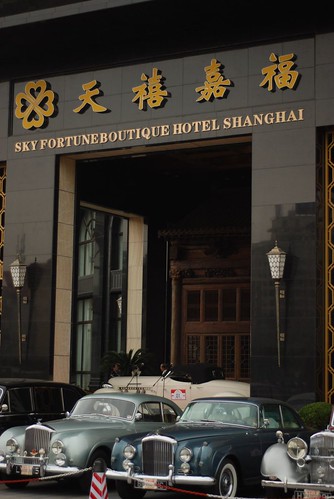
It’s not yet that Chinese mothers admonish their one-and-only child to “eat up, there are children starving back in America.” But it’s getting close. Case in point: This weekend, another Rolls-Royce showroom opened in Shenzen, Gasgoo reports. It’s the seventh Rolls Royce retail location in China. Another one, located in China’s industrial center Ningbo, will open its doors in a few months. Rollers are on a roll in China. I counted two Phantoms alone in the underground garage of my Beijing building.

At the Shenzen opening, Rolls presented their new Rolls-Royce Phantom Coupé to the Chinese public. It’s their entry model. “Nearly two-thirds of Coupé customers worldwide have not owned a Rolls-Royce before,” said Jenny Zheng, Rolls-Royce Motor Cars’ General Manager for Greater China. BMW are thanking their lucky stars…

While Rolls-Royce’s parent BMW saw its global sales slide by 15 percent in September, Rolls flipped their Emily at the flagging economy, and increased sales by seven percent in the same month. Year-to-date, Rolls-Royce sales rose a record 43 percent year-on-year. Granted, that total was only 827 cars. But in this economy, every car counts. Especially as each example retails at $415k base - and no true Roller proprietor will get caught in a riff-raff reeking base model. “There’s been an 80 per cent increase in the number of vehicles sold this year with some form of bespoke element,” says the British Autocarmagazine with the appropriate nasal accent. Not surprisingly, sales in the United Arab Emirates are up by around 70 per cent. China? Fifty percent rise.

You think it’s a fluke? Further in the same vein(ity), New Delhi’s Financial Express reports “that Mercedes Benz India has registered an impressive 47% growth in car sales for the first 10 months of the current calendar year.” Sales of C-class Benzes more than doubled. Holy cow! And by the way, Time Magazine already said two years ago that Chinese children are getting fat.

(Picture courtesy Kaeyau. Thank you!)

Sunday, November 2, 2008

Old News Of The Day: Toyota Tops GM

(First published in TheTruthAboutCars on November 1, 2008)

“Toyota Motor Corp. trumped General Motors (GM) in total car sales during the first nine months of 2008 to become the world’s top car producer for the first time,” the Mainichi Shimbun reports from Tokyo. “Huh,” say you, “hasn’t ToMoCo trampled GM already?” Not exactly, and not officially. But they are kicking ass and GM to the bottom. Unstoppably, one may add.

“GM’s sales between January and September in 2008 were down 5.8 percent to 6,655,751, according to figures released by the company on Wednesday. Toyota’s sales for the same period, including those of subsidiaries Daihatsu Motor Co. and Hino Motors, were 7,051,029, almost unchanged from last year,” writes the Tokyo broadsheet with a kuso-eating grin on their faces, in the same sentence dispelling rumors that ToMoCo had contracted the galloping auto trade tuberculosis. [NB: Mainichi is one of the top three Nipponese papers,thick with Japanese politicos. Two of Mainichi’s CEOs became Prime Ministers of the Land of the Rising Corolla.]

Officially, and unbelievably, GM is still the world’s largest automaker. The official score keeper of all things auto is the oddly French-named “Organisation Internationale des Constructeurs d’Automobiles,” better known as OICA. In OICA’s 2007 tally of units sold, GM had edged-out Toyota by 800k units, and by creative bookkeeping, such as counting sales of companies where they had only a minority share. Immediately, Toyota shouted “foul!” (Politely.) They pointed to 9,497,754 units Toyota had made (as in produced) worldwide in 2007, versus 9,349,818 made by GM. Be it as it may, in the world according to OICA, GM is still the top dog until the fat lady sings the aria of the 2008 numbers.

With a deep bow towards Detroit, the Mainichi scribes now rub it in slicker than a Tokyo oily massage: “And while GM just beat out Toyota in total sales over 2007 as a whole, good first half figures and a relatively soft blow from the economic crisis compared to its American rival mean that Toyota is set to take the top spot this year.” You bet your ketsu they will.

(Picture courtesy of pictures.businessweek.com. Thank you!)

Saturday, November 1, 2008

VW Profits Up 15%; China’s Automakers Also Doing Well

(First published in TheTruthAboutCars on October 31, 2008 )

VeeDub in Germany has just issued their numbers for the past nine months of 2008. Viewed through the prevailing “the world is coming to an end” perspective, VW’s financial results are financial pornography, performing better than the male lead in a Russ Meyer movie. We’re talking a 15 percent gain, a money shot of more than $6b pretax. From January to September 2008, VW moved 4.8m units and grabbed a 10.1 percent share of the world market, according to the usually reliable Automobilwoche [sub]. Despite of what’s happening elsewhere in the piston business, Volkswagen’s CFO Hans-Dieter Pötsch stands by his bullish guidance for 2008: the predicted numbers will ... come.

Elsewhere, China’s automakers have also released profit reports for the third quarter. From July to September, the 17 companies combined automotive revenues totaled 47.385b yuan ($6.93b), down a mere 2.9 percentage points from last year. Their net profits drooped to 747m yuan, down - oops - 62.4 percent year-on-year, laments the government’s news agency Xinhua via Gasgoo. Never mind. Profits aren’t a Chinese company’s main objective; they often leave that to their presence in Hong Kong, where taxes are low. The notable news: they ain’t losing money.
That said, China’s bad boys are from Detroit’s central casting: China’s former car giant Shanghai GM has completed only 54 percent of its 2008 sales goal. In a wise move, the joint venture reduced this year’s sales target of its Chevrolet brand by 25 percent. Likewise, big cheese Chinese automaker FAW reduced 2008 targets for its Magotan (think VW Passat B6 platform) to 70k units from the 90k target set in January. Which didn’t faze Wolfsburg one bit.

(Picture courtesy of alexisgentry.net. Thank you!)

VW’s Martin Winterkorn To World: “Don’t Panic!”

(First published in TheTruthAboutCars on October 30, 2008 )

“Was uns nicht umbringt, macht uns härter.” What doesn't kill us, make us stronger. Martin Winterkorn may not have quoted Friedrick Nietzsche in his speech at the International Zulieferer Börse (IZB), related to us via Automobilwoche [sub]. But the CEO of Volkswagen’s theme was clear. “Don’t panic!” Winterkorn said (in German). VW will emerge from the crisis “stronger than ever.” Winterkorn pointed to growth markets such as China– which did little to calm suppliers’ fears (unless they were Chinese). “In China, 100 million people have a driver’s license,” VW’s capo di tutti capi said. Correct. “Only 10 million have a private car,” he added.

Wrong. Matter of fact, nobody really knows how many private cars there are in China. Gasgoo.com once had two numbers in the same article: “The total number of private cars in China jumps 32.5% to 15.22 million units by the end of 2007,” Gasgoo wrote. A paragraph later.. “35.34 million are private cars, an increase of 20.8% from one year earlier.” It’s easy to get confused in China. But if VW, China’s largest auto manufacturer doesn’t know the market’s size, who does? OK, now you can panic. [NB: the IZB is an ingenious cost-cutting measure of VW Purchasing whereby parts suppliers meet in Volkswagen's Autostadt-- and pay for the privilege.]

(Picture courtesy of msnbcmedia4.msn.com . Thank you!)

China’s BYD EVs Headed to Europe. Then Stateside. Allegedly.

(First published in TheTruthAboutCars on October 29, 2008 )

While TTAC has Tesla on a Death Watch, aspiring Chinese EV-automaker BYD is getting massive street cred in The People’s Republic. In case you’ve got something called a life, BYD stands for “Build Your Dreams.” Since late September, “BYD” also stands for “Buffet’s Yankee Dollars.” Omaha’s Oracle liked the company so much he wrote a check for $230m for a 9.89 percent stake. [NB: Buffet knows the tax consequences lurking in a CFC-- and we're not talking chlorofluorocarbons.] Based in Shenzen, BYD is one of the world’s largest manufacturers of rechargeable batteries for cell phones. According to The New York Times, “the company also has a fast-growing auto-making unit that accounts for nearly a third of its revenue and makes fuel-efficient compact and subcompact cars for the Chinese market.” They have some bitchin hybrid and plug-in cars in the works with specs that scare the BYDickens out of the competition– if they’re half true.

Today's BYDispatches:

1.) Gasgoo reports that BYD is on course to sell 200k automotive units this year; double that next year. The F0 model (a clone of the Toyota Aygo/Citroen C1/Peugeot107) just made the Top Ten in China. The company will soon begin selling its first electric hybrid car in China, followed by an all-electric vehicle that could go 300 kilometers on a single full charge. [ED: or not.] The biggest break-through: fast-charging in 15 minutes to 80 percent capacity.

2.) Reuters reports that BYD has signed up 10 distributors for its plug-in hybrid car in Europe ahead of its targeted entry in 2010. Fleet buyers including Deutsche Post AG’s delivery arm DHL Express have indicated initial interest, or so BYD says. Henry Li, General Manager of BYD Auto’s export trade division is electrified by the news. “We’ll start selling in Europe before we get into the United States.”

3.) Motorauthority says that BYD hybrids and plug-ins will definitely be on sale in the U.S. in 2010, after BYD is done “talking to some third-party consulting and engineering companies to get a thorough understanding of the safety standards” in the U.S. Good thinking.

(Picture courtesy of Huffingtonpost. God knows where she got it from. Thank you all the same!)